God Does Not Play Dice—He Deals the Cards
“God does not play dice with the universe.”
Einstein’s famous protest against quantum randomness has echoed through decades of philosophical debate. But I’ve been sitting with a different formulation lately, one that feels truer to the texture of lived experience:
God does not play dice. He deals the cards.
This shift from dice to cards may seem subtle, but I believe it changes everything.
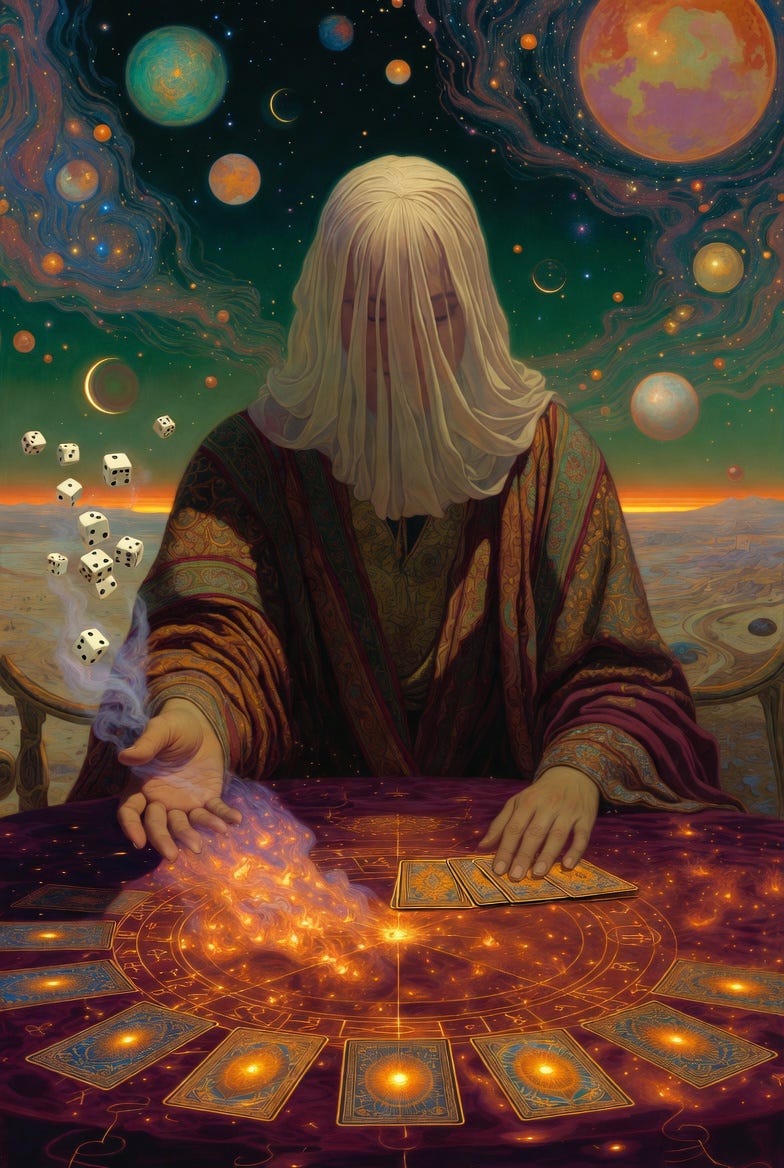
Dice are pure event. They tumble, they land, and something happens to you. There is no you in the equation after the throw. You are merely the surface the dice land upon.
But cards are different. Cards sit in your hand. They become yours in some intimate way, even though you never chose them. A terrible hand is still your terrible hand. And what you do with it becomes a kind of authorship.
I’ve often found myself caught between two unsatisfying positions when thinking about fate, chance, and meaning.
The first is the overclaim: everything happens for a reason. This can become a kind of nihilistic—where the universe acting on everything and there is no curating your own storyline.
The second is the underclaim: it’s all blind randomness. Our search for meaning or pattern is merely a story we tell ourselves. This position leaves us hollow, stripped of the sense that our lives participate in something larger.
But there is a middle position—harder to articulate, but I think it’s where truth lives.
The deal is real. The randomness is genuine. You cannot control your circumstances, your capacities, your challenges. They arrived according to laws you cannot see and a logic you cannot appeal to. The cards of your past have already been dealt—no reshuffling allowed. The cards of your future wait in a deck you cannot peek at.
And yet.
The game exists. The fact that there is a hand to play, that playing matters, that meaning can be made from cards you hold—this is not nothing. It is, perhaps, everything.
I find myself drawn to the idea that randomness and purpose are not opposites. The universe may not be dictating every card, but it has constructed a game in which cards mean something. The randomness gives us the raw material. The structure of the game gives us the invitation to participate.
This is a subtle theology. Or perhaps a subtle philosophy—the line blurs here.
The Sacred doesn’t need to control the dice to still be present in the game. It doesn’t narrate every twist to still hold the whole. Perhaps our lives is not in the content of the cards but in the space that opens up when you receive them and must decide what to do.
The deal keeps coming. You cannot will the next card into being. You cannot refuse the ones already in your hand.
But you are here, holding them. And that holding is where another kind of story begins—one that belongs to you.
That story is for another exploration.


Comments